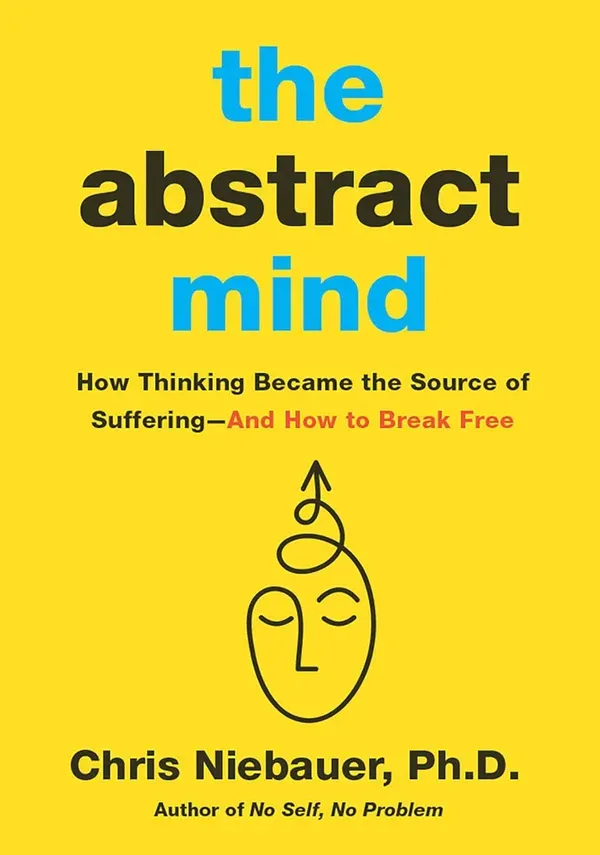
Book cover reading 'The Abstract Mind' with a yellow background and a line drawing of a serene face with a swirling arrow

The Abstract Mind: How Thinking Became the Source of Suffering

Your mind spends most of its time dreaming. It's time to wake up.

AVAILABLE NOW - BUY ON AMAZON

What is The Abstract Mind about?

Our ability to think abstractly is humanity’s superpower. It gave us language, art, science, and civilization. Before a wheel was built, it was imagined. Before a law was written, it was conceived. Abstraction lets us plan, create, and transcend our immediate circumstances.

But this gift has a shadow. The same mind that builds bridges also builds prisons—of worry, comparison, and endless mental chatter. We fret over insults that never came, chase status that can’t satisfy, and wage wars over lines on a map. The abstract world, once a tool, has become our cage.

In The Abstract Mind, bestselling author and cognitive neuropsychologist Chris Niebauer illuminates how abstraction creates illusions that interfere with our perception of reality, how these illusions give rise to mental suffering, and how, with a little practice, you can learn to see through them. This book isn’t another guide to mindfulness. It’s a mirror—one that reveals how deeply we’ve confused thought for life. Like a dreamer realizing they’re asleep, the moment you notice the abstract world is a mirage, the spell begins to break.

The ladder of abstraction

At the heart of the book is a simple picture of how the thinking mind works. At the bottom are the most grounded concepts, closest to physical reality: the chair you're sitting on, the air on your skin. Higher up are ideas the mind builds on top of those, and at the very top are concepts that exist only as imaginative constructions of the mind.


The higher rungs aren't the problem. Abstract ideas give us science, planning and art. The trouble starts when we forget they are abstractions and treat them as just as real as the ground beneath our feet. Worry, comparison and much of our everyday suffering live at the top of the ladder.


The final part of the book turns to the most abstract concept of all: the self. It picks up where Chris Niebauer's earlier book, No Self No Problem, left off.

Who is The Abstract Mind for?

Anyone who has felt caught in their own head: readers curious about the brain, students of meditation and Eastern philosophy, and anyone who suspects that the stories the mind tells are not the whole of life.

Chris Niebauer, Ph.D. is a cognitive neuropsychologist and professor at Slippery Rock University in Pennsylvania who teaches courses on consciousness, mindfulness and the differences between the left and right brain. Learn more about the author.

Put down your phone. Feel the air on your skin. Listen to the hum of the world.

This is where life happens—not in your head, but here. Now.

Welcome back.

Reader reviews

What people are saying

An inspiring and informative take-down of abstract concepts

Abstract concepts can be useful but also a source of great suffering when they are reified and serve no purpose. Chris Niebauer presents a simple but useful abstract concept of his own, a metaphorical ladder of the most "grounded" concepts at the bottom of the ladder, closest to physical reality, to "higher" (more abstract) concepts that are purely imaginative constructions of the mind. The most abstract concepts at the top of the ladder can be incredibly useful, for example, scientific models that connect to the physical world. But, too often, we fixate on abstract concepts as if they were just as real as physical objects, and the consequences are mostly negative. It can be difficult to see this in everyday life because everyone else is believing in concepts such as moral goodness, human rights, fairness, ownership, and money as if these are physically real things instead of just social constructions of reality. They are reinforcing our faulty thinking about abstract concepts. Niebauer's book is the antidote to wrongheaded thinking about abstract concepts. The last portion of his book is about the ultimate abstract concept, The Self, and is thus a continuation of his previous excellent book, No Self, No Problem. I strongly recommend both books.

John A. Johnson

Where neuroscience meets spiritual practice

“I loved this book. Chris Niebauer has a rare gift for integrating psychology and neuroscience with spiritual practice and personal development, and The Abstract Mind shows that gift at its best.”

Victoria

Just take a minute, stop and wonder.

Amazing little book. What Niebauer does is rare. He writes devoid of any intellectual academic boasting so that we can all enjoy the wonders of science and philosophy at human level and pace. At the same time this book is profoundly deep and full of insight. Just like "No self..." a superb read. The humor and lightness is another of Niebaur's traits, that I just love. Keep ’em coming, Chris!

Peter Winding

Frequently asked questions about The Abstract Mind

Is The Abstract Mind a mindfulness book?

Not in the usual sense. It isn't another guide to mindfulness; it's a mirror that shows how deeply we've confused thought for life. It explains how abstraction creates the illusions behind mental suffering and how, with a little practice, you can learn to see through them.

How is it different from No Self No Problem?

No Self No Problem focuses on one illusion: the sense of self created by the left side of the brain. The Abstract Mind widens the lens to abstraction itself, including worry, comparison, status and the stories we live inside. Its final part returns to the self as the most abstract concept of all.

Where can I buy The Abstract Mind?

The Abstract Mind is available now on Amazon.